Learn
How to Play American Mah Jongg
Last reviewed July 9, 2026
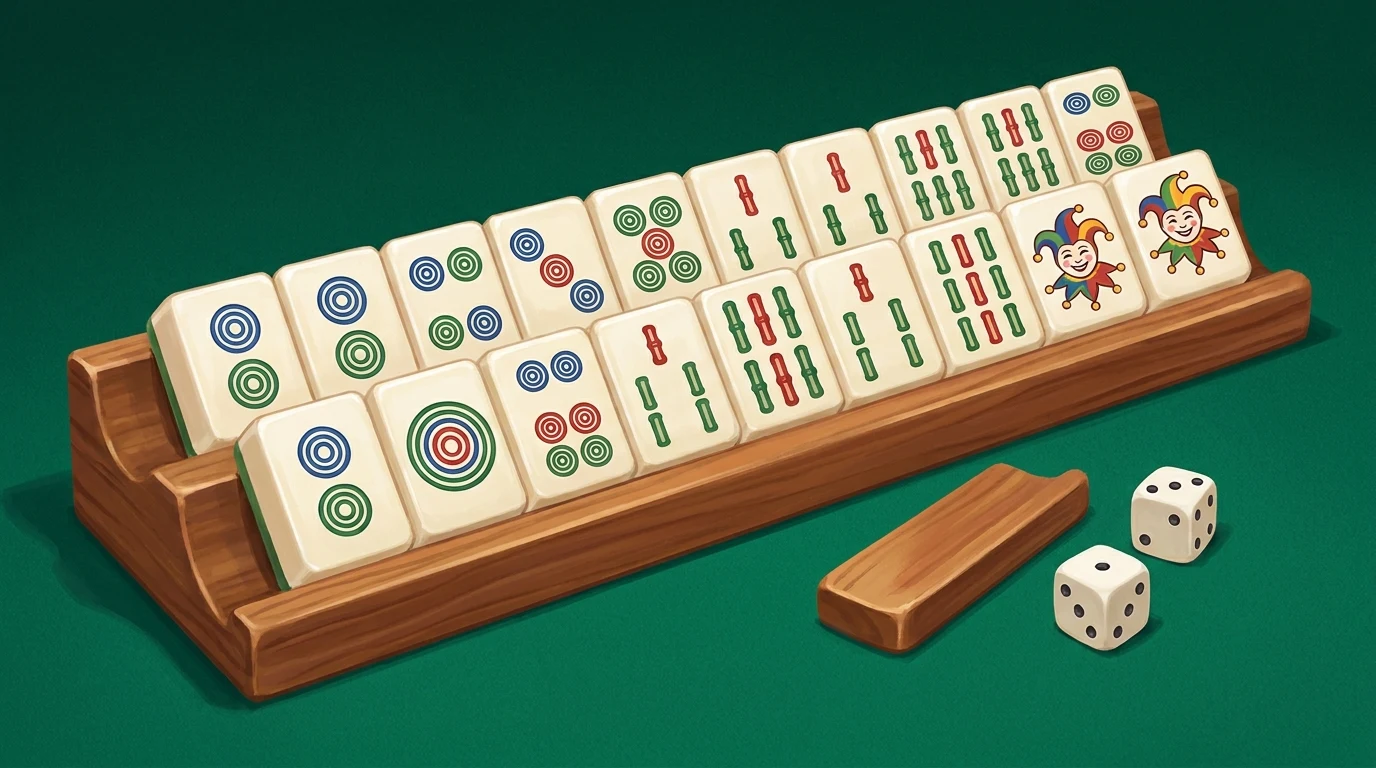
American Mah Jongg is a tile game for four players in which you race to build a hand that matches one line on a printed card of legal hands, reissued every year by the National Mah Jongg League. It is the version most people in the United States mean when they say mah jongg, and it has three things the older Chinese game does not: eight wild jokers, that annual card, and a tile-passing ritual called the Charleston.
The set
You play with a 152-tile set. That is the three suits, bamboo, circles, and characters, numbered one through nine; the four winds and the three dragons, the red , green , and white ; eight flowers; and eight jokers. Retail boxes often hold more than that, with spare jokers, flowers, and blank replacement tiles, but 152 are the ones in play.
The card is the whole game
Every spring the League prints a new card listing that year's legal hands, grouped into sections, with a point value beside each one. Your goal is narrow and exact: complete a hand that matches one full line on the current card. A hand that is not on the card cannot win, however pretty it looks. Because the hands change each year, regulars relearn the card every spring, which is half the fun and the reason the card is its own yearly event.
We do not reproduce the current card here. It is the League's to publish and sell, and you buy it from them directly. What we can teach is everything around it, how a hand comes together and how the game is played.
Setting up
Four players sit as the four winds. A roll of the dice sets the dealer, who plays as East. Each player builds a wall of tiles in front of them, and tiles are dealt around until everyone holds thirteen, with East holding fourteen to begin the action.
The Charleston
Before play begins comes the Charleston, a blind exchange found in no other version of the game. You pass three unwanted tiles to the right, three across, and three to the left. Then, if everyone agrees, a second Charleston runs the other way: left, across, and right. A short courtesy pass across the table can follow, zero to three tiles by mutual agreement. The Charleston is how a rough opening hand becomes a workable one, and it rewards reading what your neighbors are throwing away. Tables vary on the fine print, so when in doubt, defer to the room and to the League's own rulebook.
Playing a turn
On your turn you draw a tile and discard one, going counterclockwise. When another player discards a tile you need, you may claim it, but only to expose a complete group your hand calls for: a pung, three of a kind; a kong, four; and, when a hand on the card asks for it, a quint, five, or a sextet, six. You lay that group face up for the table to see.
Shown with the 5 of circles. A joker can fill any group of three or more, but never a single or a pair.
Here is the one big break from the Chinese game: you cannot call a discard to make a run of consecutive numbers, the chow. Runs in American hands are built only from tiles you draw yourself.
The jokers are what give the American game its friendly reputation. A joker can stand in for any tile inside a group of three or more identical tiles, a pung, kong, quint, or sextet. It cannot be a single tile, and it cannot be half of a pair. On your own turn you can also redeem a joker, swapping in the real tile it represents from any exposed group on the table.
Building a hand
Now put the pieces together. Before the Charleston you read the card, pick a hand that suits the tiles you were dealt, and build toward that exact pattern. Here is what one finished hand can look like. Say you are chasing the number five in all three suits, with flowers and a pair of dragons:
A made-up hand, not one from any real card, drawn only to show the shape: fourteen tiles in five clusters. Flowers all count as matching. The real hands, and what each is worth, live on the League's card.
Read it the way the card does, as a pattern of groups: two flowers, a pung of five circles, a kong of five bamboo with a joker filling the fourth tile, a pung of five characters, and a pair of green dragons. On the real card, color carries meaning, it tells you whether matching groups must share a suit or, as here, come from three different ones. You claim discards to fill the pungs and the kong, draw the rest yourself, and it is smart to keep a second hand in mind in case the tiles refuse to cooperate.
Concealed and exposed hands
Every line on the card is marked either exposed or concealed, and that changes how you build it. On an exposed hand you may claim discards and lay each group face up as you finish it, the way just described. On a concealed hand you claim nothing and show nothing: the whole hand stays hidden behind your rack, built only from tiles you draw yourself plus the single one you win on. Concealed hands are harder to land, so they usually pay more. Same target either way, the difference is whether you build it in the open or out of sight.
Winning
You win by completing a hand that matches a line on the card and calling Mah Jongg, on a tile you draw yourself or one another player discards. Each hand on the card carries a point value, and the winner is paid by the other three. Conventions differ from table to table, but the shape holds: throw the tile someone wins on and you pay double; win on a tile you drew yourself and all three pay double; finish without a joker and the hand is usually worth more. The card has the final say on what a hand is worth.
Where it comes from
For all that makes it distinctly American, this is a Chinese game at heart, carried to the United States in the 1920s and standardized by the League in 1937. The tiles you are learning, the suits drawn from old strings of coins, the winds, the dragons, are pieces of Chinese tradition. It is worth knowing where they come from.
Sources
- American mahjong and Mahjong tiles, Wikipedia.
- Tom Sloper's American mah-jongg FAQ (the Charleston, pungs and kongs, jokers).
- The Charleston, American Mah-Jongg Association.
- The National Mah Jongg League (the annual card; buy it from the League directly).
The fastest way to make all of this stick is a real table with patient players. Find a game near you - library afternoons and JCC groups teach beginners every week.