History
Where Mahjong Comes From
It began in China
Mahjong is a Chinese game. It took shape in the second half of the nineteenth century in the cities of the Yangtze delta, around Shanghai and Ningbo, built out of older Chinese games played with cards and tiles. By the 1880s it was being played and refined across the late Qing and carried along the trade routes that ran through it.
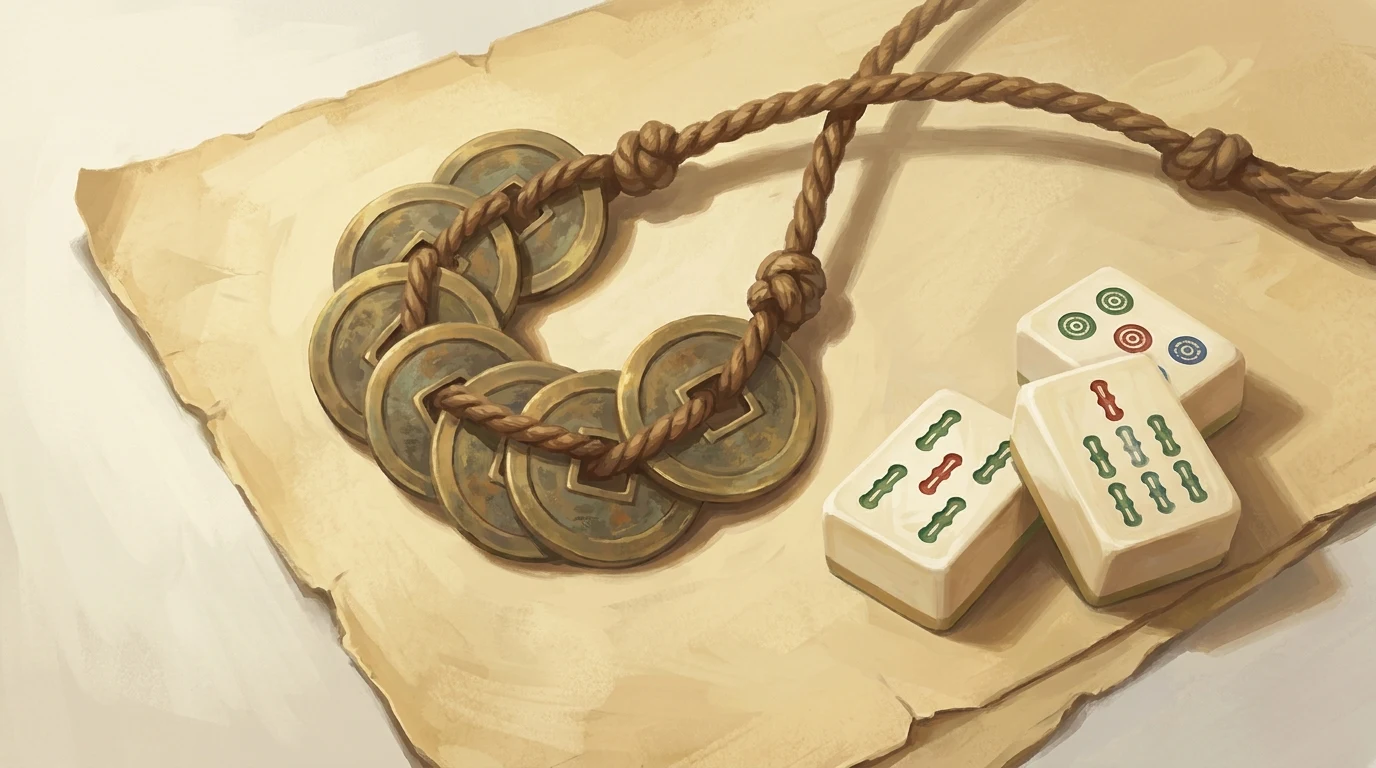
You can read that origin off the tiles. The three suits, bamboo, circles, and characters, descend from strings of old Chinese coins. The winds are the four directions. The dragons, the flowers, and the seasons each carry a piece of Chinese symbolism. To learn the tiles is to handle a small museum of it.
It traveled
In 1920 Joseph Park Babcock, an American working for Standard Oil in Shanghai, published the slim red rulebook he trademarked as Mah-Jongg. The timing was perfect. Within a few years the game was an American craze: importers could not land sets fast enough, Abercrombie & Fitch sold them as quickly as they arrived, and there was sheet music written about it.
The craze came dressed in the Orientalism of the decade. American sets and advertising costumed the game in a cartoon version of the East, and the instinct to treat a Chinese game as a theme rather than a tradition did not end when the fad did. As recently as 2021, an American company sold a “refreshed” set that swapped the traditional Chinese designs for American motifs, and a wave of Chinese American players objected; the company apologized.
It put down roots
The fad passed; the game stayed. In 1937 a group of Jewish American women in New York founded the National Mah Jongg League, fixed an American version of the rules, and printed a card of legal hands they have reissued every year since. The jokers, the Charleston, the spring ritual of learning the new card are American inventions, and they are what make the American game its own. Over the decades that followed it became an institution of American Jewish women's life in particular, a standing weekly table that has carried friendships across generations. A Chinese game had found a second home.
It was always more than one game
There was never only one mahjong. Hong Kong and Cantonese play are the most widespread forms of the Chinese game; Taiwan plays with sixteen tiles; Japan built Riichi, with a depth of strategy and, lately, an animated and online following all its own. Across the Chinese diaspora and well past it, families keep house rules of their own. The game answers to no single owner, ethnic or corporate; it belongs to the people who play it.
The fullest account of how it moved through the world is Annelise Heinz's Mahjong: A Chinese Game and the Making of Modern American Culture (Oxford University Press, 2021). If we have a date or a framing wrong, tell us.