Learn
An Introduction to Japanese Riichi Mahjong
Last reviewed July 9, 2026
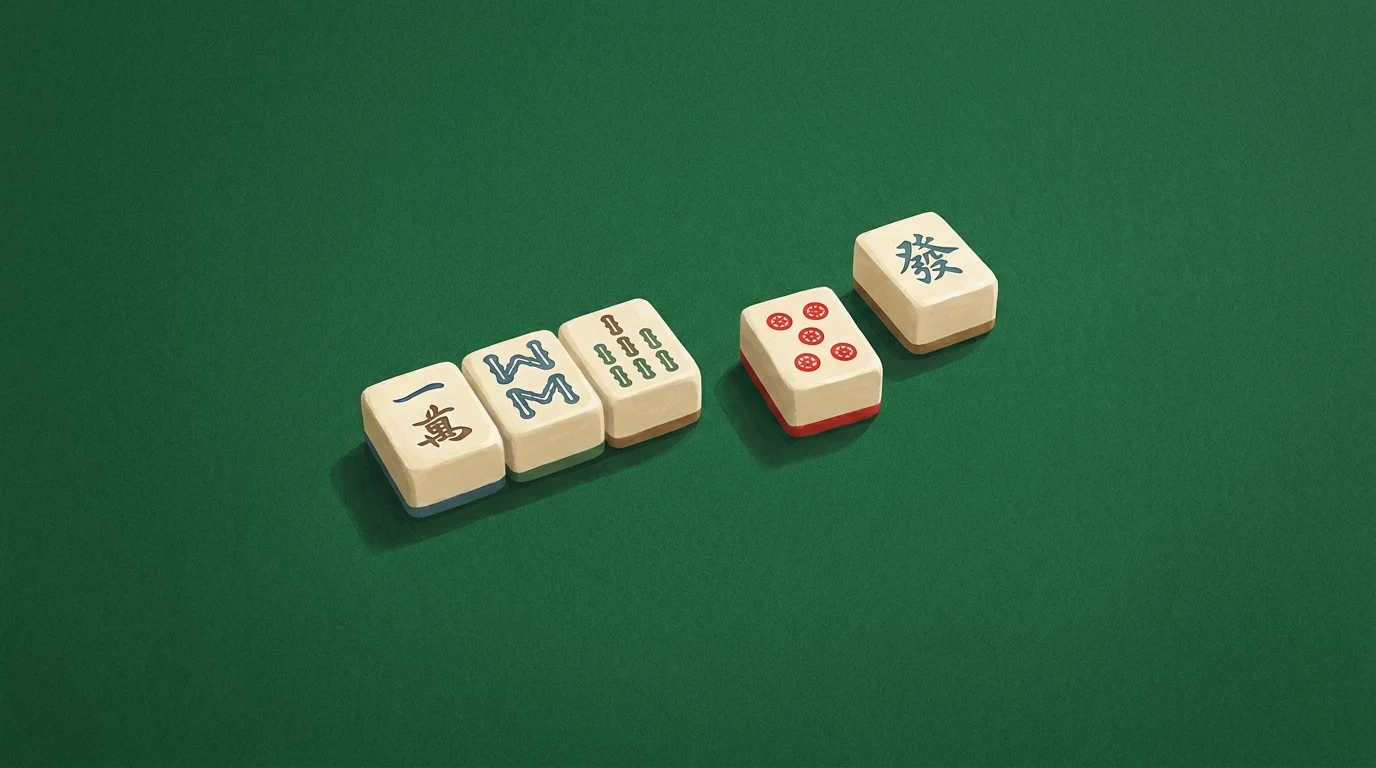
Riichi is the Japanese form of mahjong. The game itself is Chinese; it reached Japan around 1924 and, over the decades that followed, grew its own distinctive scoring and rules. What came of that is the most strategy-heavy form of the game played today, with a large global following sharpened by anime and online play. This page is an introduction, not a full rulebook: enough to know what you are looking at, and where to go to learn it properly.
The set
Riichi is played with 136 tiles. That is the three suits, bamboo, circles, and characters, numbered one through nine; the four winds; and the three dragons, the red , green , and white . There are no flower or season tiles. Many modern sets add red fives, called akadora, which replace an ordinary five of a suit, so the count stays at 136.
Four players sit down to play. Each starts with thirteen tiles, and a winning hand is fourteen: four melds and a pair.
The same four-melds-and-a-pair shape as the Chinese game, with no flowers or seasons. The white dragon pung is a yaku, the scoring pattern a hand needs before it can win.
What makes Riichi distinct
The shape of a hand is familiar to anyone who has played mahjong, but a few rules give the Japanese game its character. For a newcomer, these are the ones to hold onto.
You need a yaku to win. A yaku is a recognized scoring pattern, and a hand must contain at least one. Simply completing four melds and a pair is not enough on its own; without a yaku, a finished-looking hand cannot be declared a win.
Riichi is itself a declaration, and it is where the game gets its name. When you are holding a closed hand that is one tile away from winning, you can bet 1,000 points and announce riichi, committing to that hand.
Dora are bonus tiles that increase a hand's value. They do not help you complete a hand, but holding them makes a win worth more, and the akadora red fives are a common source of them.
Furiten is a rule that prevents you from winning on a tile you have already discarded. It is one of the things that makes reading the discards, your own and everyone else's, central to playing well.
Where to go deeper
This is the part where an introduction should know its limits. Riichi is deep, and it is already served by excellent, thorough references that cover the full yaku list, scoring, and strategy in the detail they deserve. We would rather point you to them than half-teach the game here. The community resources below are the place to learn it properly, and online clients such as Mahjong Soul are a low-friction way to start playing once you have the basics.
For all that Riichi has become its own tradition, it began as a Chinese game. If you want that part of the story, it is worth knowing where the tiles come from.
Sources
- Japanese mahjong and Mahjong tiles, Wikipedia.
- Riichi Wiki (the community reference for the full rules, yaku, and strategy - go deeper here).
Getting a riichi set
Riichi tiles carry no Arabic numerals and no jokers, and good sets include the red fives, so buy one made for the Japanese game rather than an American or Chinese set. We track a few in the sets catalog (filter to Japanese).